
en
If you've only used crypto exchanges, you've been trusting someone else to hold your assets. Self-custody changes that. Here's what it means.
If you've only used crypto exchanges, you've been trusting someone else to hold your assets. Self-custody changes that. Here's what it means.
Self-custody means you (and only you) control your cryptocurrency. No company, no exchange, no third party can access your funds.
Think of it like cash: A bank holds your money and can freeze your account. Cash in your wallet is yours to control. Self-custody is the "cash in your wallet" version for crypto.
When you buy crypto on an exchange:
This is called custodial storage - the exchange has custody of your assets.
With a self-custody wallet like KriptoK:
Your crypto lives on the blockchain. Your wallet is the tool that lets you access it.
1. True Ownership
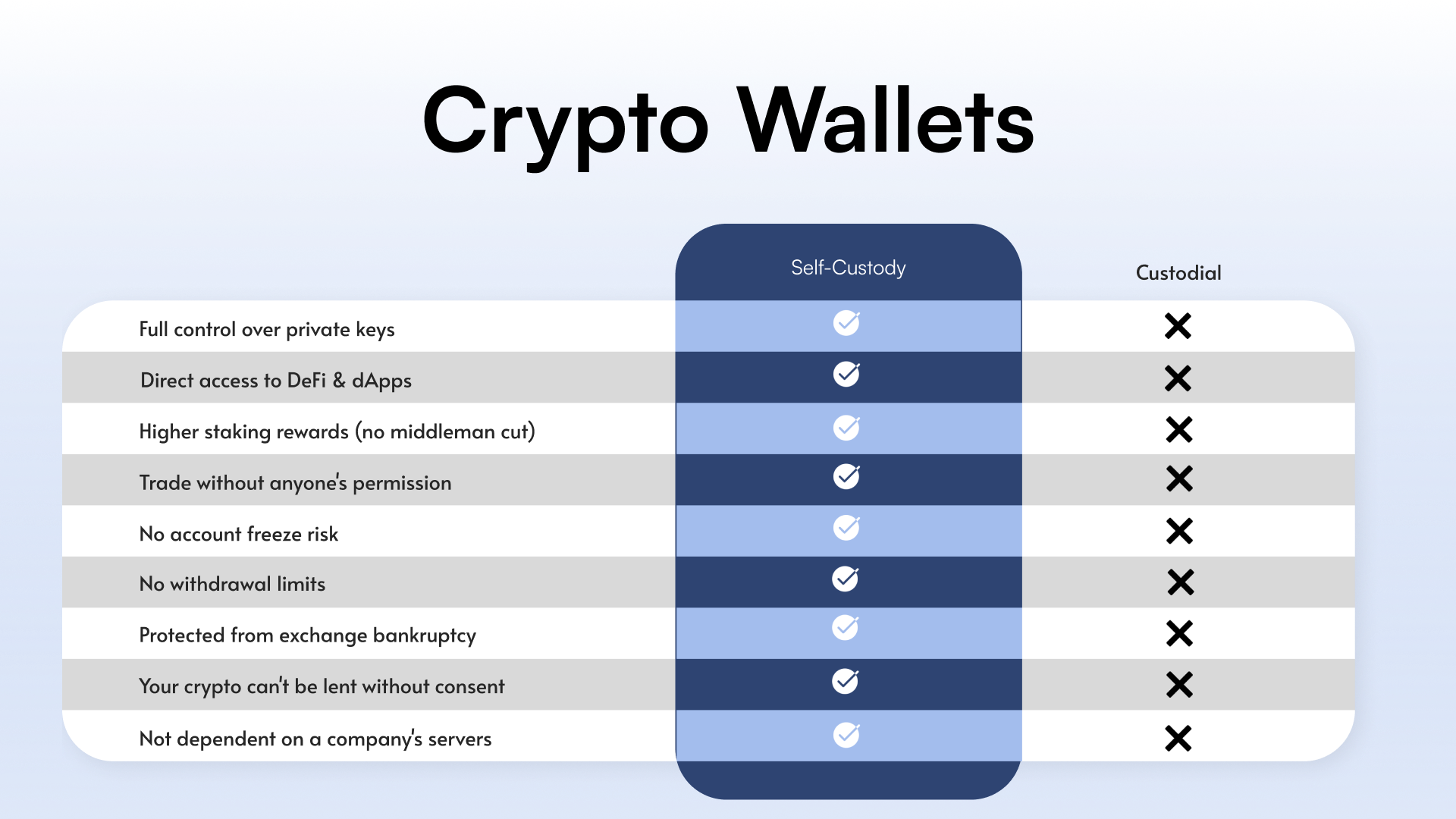
On an exchange, you see a balance but don't directly control the underlying crypto. With self-custody, you own the actual crypto on the blockchain.
2. No One Can Freeze Your Funds
Exchanges can freeze accounts for regulatory reasons, suspected fraud, technical issues, or bankruptcy. Self-custody eliminates this risk.
3. No Withdrawal Limits
Exchanges impose daily limits. Self-custody wallets don't.
4. No Middleman Risk
When exchanges fail, users lose funds. FTX, Mt. Gox, and others collapsed. Self-custody removes this single point of failure.
5. Privacy
Exchanges collect your identity and track your transactions. Self-custody wallets don't require personal information.
Self-custody gives you control, but it also means you're responsible for security.
What this means:
This isn't meant to be discouraging. It simply means that with ownership comes accountability. Many people find this trade-off worthwhile for the freedom and security it provides.